Architect Barbie Now a Reality
And now on to the topic at hand.
As architecture/interior design students, we are always asked to do some relatively extensive precedent study as we begin our design process. Nobody is telling us we should outright steal our ideas from anywhere, but we are asked to find a sort of justification for whatever we had in mind - proof that what we want to do has worked in some form somewhere else. Also as students of design, we are being prepped to be the next generation of thinkers in our field. A lot of the time we'll be beholden to a client and what they're familiar with, but it doesn't hurt to have the ability to think completely outside of the box and then reign it in as necessary. We're not being told, take this classical order and completely recreate it in the form of a coffee bar.
Autonomous architecture is all about flexibility and transformation. It means that we can create new designs that don't have to be literal, that can be interpreted in countless ways, and that what is understood to have the function or appearance of a column etc isn't necessarily a typical column or door. The best example that comes to mind from our very own SoA is the use of the words "opening" and "transition" instead of the word "door." This careful phrasing means that when we talk about our designs, people don't get bogged down in the connotation of what a door is. I think that in the future, we should all talk about our designs this way. It leaves room for the imagination of possibilities when it comes to created places.
What this class, other theory classes, and studio has taught us in this program is that we should understand the essence of things and their basic forms and functions, and then question those things and consider how we can convert, invert, or subvert them. This is what I think autonomous architecture is all about. When we fully comprehend concepts, we can apply them in complex and unexpected ways, instead of just seeing them and copying them in slight variations. This way we generate form in original ways. This means that our designs will get their own legs, so to speak, and people can interpret them somewhat apart from context.

Architecture, design, pop culture, and rocking your world view.
Wednesday, February 23, 2011

Thursday, February 17, 2011
Didier Faustino's "Double Happiness" Installation
In keeping with the theme of the relationship between people and urban space, I found this interesting piece about Didier Faustino's statement installation - a swing set made out of a billboard.
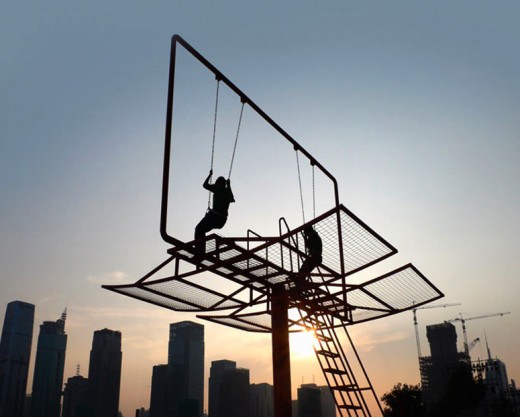
"Double Happiness responds to the society of materialism where individual desires seem to be prevailing over all."
"Double Happiness responds to the society of materialism where individual desires seem to be prevailing over all."
Wednesday, February 16, 2011
Reading #7: On Radicalism and Archigram's Amazing Technicolor Dream Crusade
I used to think that Radical architecture was kind of ridiculous, which wasn't helped by Mr. Moran's characteristically flamboyant way of lecturing about things. Some of the concepts that were the product of the Radical movement just seem downright ludicrous. The idea of blimps (named Rupert) depositing things in the middle of the night, in a city which might be composed of giant pods on legs that serve as housing, HOW ABSURD!

Well actually it's not. Even though some of their designs end up looking like sea urchins, it was a pretty good idea to think of the metropolis as an ORGANISM rather than a collection of discrete buildings bound together only by the ground plane. The drawn ideas look kind of like steampunk octopi, but the driving philosophies of the Radicals should still be considered relevant today. Designers should constantly consider the "relationship between urban space and human behavior."
What are some of the typical aspects of urban space? The positives: cultural melting pot, diversity of opportunities and experiences, socialization, public transport (if you think of that as a positive). The negatives: large income gap, high crime rates, pollution, high living expenses, and sheer population density. Lots of people favor living in the suburbs with a relatively short commute to urban centers so that they can have the best of both worlds - breathing space as well as cultural opportunity. The fact of the matter is that urbanism has an impact on the mindset of the people who live in it, and they tend to become part of this city-dwelling machine that tends to be fast-paced self-preservation from point A to point B avoiding as much traffic as possible.
Well actually it's not. Even though some of their designs end up looking like sea urchins, it was a pretty good idea to think of the metropolis as an ORGANISM rather than a collection of discrete buildings bound together only by the ground plane. The drawn ideas look kind of like steampunk octopi, but the driving philosophies of the Radicals should still be considered relevant today. Designers should constantly consider the "relationship between urban space and human behavior."
What are some of the typical aspects of urban space? The positives: cultural melting pot, diversity of opportunities and experiences, socialization, public transport (if you think of that as a positive). The negatives: large income gap, high crime rates, pollution, high living expenses, and sheer population density. Lots of people favor living in the suburbs with a relatively short commute to urban centers so that they can have the best of both worlds - breathing space as well as cultural opportunity. The fact of the matter is that urbanism has an impact on the mindset of the people who live in it, and they tend to become part of this city-dwelling machine that tends to be fast-paced self-preservation from point A to point B avoiding as much traffic as possible.
Monday, February 7, 2011
Wednesday, February 2, 2011
STARchitecture
The architect and his designs as a “spectacle” have destroyed the integrity of reality and made the world of architecture mere iconography. Star architects are less beholden to certain emotions and values of the design process; frequently their clients don’t dictate requirements for the end product so much as they think “I just want a building by Thom Mayne.”
How much team work is involved in the production of a design by a star architect? Is it really the work of only the star architect, run rampant and unchecked by any other architects or consultants of equal standing? Or is it the result of a team of minions that take care of miniscule details, the product gets stamped with approval from the head-honcho starchitect, and they become famous for what was really just a broad gesture from them?
In lesser firms composed of several architects or designers of equal skill and stature, though they may have their individual projects to work on, the design process has built-in checks and balances not only among the partners, ensuring that one partner hasn’t gone off the deep-end, but with the client as well. The client can generally afford to be picky, and if the designers aren’t producing above and beyond what the client dreams of, they’re off the project. If you manage secure Peter Eisenman as a designer, would you tell him he can’t put a giant unsealed hole in your roof if that’s what he wants?
What is the difference between “real” and “appearance?” Something that’s confused me over the last year is why people are so willing to spend money on the luxury of viewing movies in 3D or buying a 3D television when life is already in 3D? I accept that movies and television shows are artifice, and I can be engaged without being immersed in it. American society somehow believes more in the fantastical than the real. The difference is that the “real” is ultimately more fulfilling, carries more weight and integrity, than illusion. Illusion cannot be experienced beyond the visual, it cannot be questioned with the expectation of receiving answers, and it cannot be deconstructed without being destroyed.
Star architects, having achieved a level of fame or notoriety, no longer have the need to explain themselves. They are allowed to produce designs that aren’t required to hold their water (I’m looking at you, Frank Gehry). It is undeniable that the star architects have talent and vision, otherwise they couldn’t be in their current positions of prominence. But I think that in being somewhat of a celebrity and having already proved themselves (like a tenured professor), some might stop holding themselves to the standards that everyone else has to follow.
Wednesday, January 26, 2011
Reading #5: Team 10
Sometimes when I'm reading the articles for class I like to pretend that the information I'm reading is related to something else. For example, Team 10 reminds me of the rebellious teenage offspring of the tightly-wound parent that was the CIAM. The loose grouping of architects seemed to stick their middle finger to the air and say, "I'll never do what my father did!" and try to rid the world of crimes against architecture and urbanism. On that note, I also liked to think of the members of Team 10 as a league of superheroes. But anyway.
The biggest flaw of Team 10 was that the core group seemed to forget that there's no "I" in "team" and by maintaining their own outspoken philosophies about architecture and urbanism, they contributed to their own dissolution. Each member, for the most part, believed in the philosophy that architecture can be built on society's own natural drive, the relationships between people, their "habitats", and their communities, but they faced many disputes and heated discussions that likely ultimately hindered their ability to apply the philosophy that was their common ground. Idealism always seems to have a way of bringing out the worst in people.
Architects seem to run into trouble when they start trying to analyze people. The Modernists' ideals were based on the idea of industry and mass production, essentially reducing people to no more than Consumer #3275 or Inhabitant #8014. It kind of worked for Corbu's Unite' d'Habitation, but failed spectacularly in Pruitt Igoe. Team 10 was focused on getting to the root of people's behaviors and patterns, sort of looking at the underlying motivations for people as a society while simultaneously emphasizing individuality. It's hard for an architect or a designer to accommodate the different levels of a person's identity - as anonymous part of a population, or as Susie Smith the accountant from Lincoln, Nebraska who one day dreams of owning a condo in Fiji. And while we all like to think of ourselves as unique beautiful snowflakes, looking at us as a crowd one can see that we move in similar and predictable ways. So then why shouldn't our "habitats" be similar and predictable? Also, in our quest to be at the forefront of technology or individuality, we disconnect ourselves from our population and our environment, isolating ourselves and making our internal world the only thing we see, not the sameness or different-ness of our habitats, so then does it matter if we have cookie-cutter urban centers?
The biggest flaw of Team 10 was that the core group seemed to forget that there's no "I" in "team" and by maintaining their own outspoken philosophies about architecture and urbanism, they contributed to their own dissolution. Each member, for the most part, believed in the philosophy that architecture can be built on society's own natural drive, the relationships between people, their "habitats", and their communities, but they faced many disputes and heated discussions that likely ultimately hindered their ability to apply the philosophy that was their common ground. Idealism always seems to have a way of bringing out the worst in people.
Architects seem to run into trouble when they start trying to analyze people. The Modernists' ideals were based on the idea of industry and mass production, essentially reducing people to no more than Consumer #3275 or Inhabitant #8014. It kind of worked for Corbu's Unite' d'Habitation, but failed spectacularly in Pruitt Igoe. Team 10 was focused on getting to the root of people's behaviors and patterns, sort of looking at the underlying motivations for people as a society while simultaneously emphasizing individuality. It's hard for an architect or a designer to accommodate the different levels of a person's identity - as anonymous part of a population, or as Susie Smith the accountant from Lincoln, Nebraska who one day dreams of owning a condo in Fiji. And while we all like to think of ourselves as unique beautiful snowflakes, looking at us as a crowd one can see that we move in similar and predictable ways. So then why shouldn't our "habitats" be similar and predictable? Also, in our quest to be at the forefront of technology or individuality, we disconnect ourselves from our population and our environment, isolating ourselves and making our internal world the only thing we see, not the sameness or different-ness of our habitats, so then does it matter if we have cookie-cutter urban centers?
Wednesday, January 19, 2011
Reading #4: Structuralism and Its Applications
The failing of the modernist movement was that it envisioned an idealistic world and social construct and sought to force people into the confines of the modern utopia. The Modernists saw the problems with urban sprawl and believed they could fix them with a sterile, highly formulaic architectural solution. The Modernist solution only worked formally in personal houses or commercial buildings, but Modernist housing complexes like Pruitt Igoe simply didn't work - the problems with urban sprawl had everything to do with the human condition and their natural tendencies, not because of flawed buildings or neglectful urban planning.
The intention of the structuralist philosophy was to combat the overturning of social constructs, instead examining social constructs, typology and semiotics and applying them to architectural form and organization. Then the post-structuralists came along and decided that objective or intended interpretations of elements were secondary to whatever the interpreter felt in relation to his or her own feelings. Post-modernism rejects the notion of bi-polar constructs like such as black/white, male/female etc. The post-modernists revived the symbolic and ornamental aspects of architecture.
I strongly disagree with Venturi's statement that "less is bore." I think ornament for the sake of ornament is overkill. A lot can be said with the eloquence of clean lines, pure forms, and basic surfaces. Simple isn't necessarily "simplistic." Take Mies van der Rohe's Barcelona Pavilion. It utilizes pure geometry and clean lines, but the luxe materials and the intricate intersection of elements are enough ornament to make the structure compelling. Then take Post-modernism. It seems to be almost a universal sentiment among architecture professors (at least at Tech) that post-modern architecture is ugly (to keep it PG). So maybe the post-modernists and post-structuralists had the right idea in not trying to force people into paradigms, but the modernist architects had a more forward-thinking concept of design.
The intention of the structuralist philosophy was to combat the overturning of social constructs, instead examining social constructs, typology and semiotics and applying them to architectural form and organization. Then the post-structuralists came along and decided that objective or intended interpretations of elements were secondary to whatever the interpreter felt in relation to his or her own feelings. Post-modernism rejects the notion of bi-polar constructs like such as black/white, male/female etc. The post-modernists revived the symbolic and ornamental aspects of architecture.
I strongly disagree with Venturi's statement that "less is bore." I think ornament for the sake of ornament is overkill. A lot can be said with the eloquence of clean lines, pure forms, and basic surfaces. Simple isn't necessarily "simplistic." Take Mies van der Rohe's Barcelona Pavilion. It utilizes pure geometry and clean lines, but the luxe materials and the intricate intersection of elements are enough ornament to make the structure compelling. Then take Post-modernism. It seems to be almost a universal sentiment among architecture professors (at least at Tech) that post-modern architecture is ugly (to keep it PG). So maybe the post-modernists and post-structuralists had the right idea in not trying to force people into paradigms, but the modernist architects had a more forward-thinking concept of design.
Bonus Blog 1: Michel Rojkind
Yesterday's lecturer was a man of bombastic personality and inspiring vivacity. My favorite projects discussed were the apartment for the ballerina consisting of folded, twisted planes and the multipurpose tower with "communities" designated by different metaphysical and/or natural elements. The ballerina apartment is an embodiment of the undulation, the contortion, and the twisting nature of dancing. The multipurpose tower, despite its forty storeys, subverts the notion of the monolithic high rise by separating the floors into groups of elemental themes. I also liked the L'oreal/Nestle' labs and the project with the orange facade, internal gardens and theoretical iguanas.
I think Vitruvius would be proud of Rojkind because of his well-rounded capabilities. He could have been a rock star, yet he insisted on going to school and proving himself as an architect even when his professors told him to quit wasting their time and go be a drummer. What is particularly impressive that having studied architecture while being a drummer and being discouraged, he went on to build an independent firm that has been recognized by Architectural Record as a top ten Design Vanguard firm. Additional testament to his well-roundededness is his team project redesigning the soccer ball.
His presentation was by far one of the best I've seen in the lecture series since my first year. I liked his reiteration of the fact that "the time for being passive is over" (which earned a slow clap from someone in the audience). This is key in today's design world: design must move forward in an active and deliberate way; though sometimes fortuitous epiphanies happen, but by and large a designer pushes forward intentional elements and decisions.
I think Vitruvius would be proud of Rojkind because of his well-rounded capabilities. He could have been a rock star, yet he insisted on going to school and proving himself as an architect even when his professors told him to quit wasting their time and go be a drummer. What is particularly impressive that having studied architecture while being a drummer and being discouraged, he went on to build an independent firm that has been recognized by Architectural Record as a top ten Design Vanguard firm. Additional testament to his well-roundededness is his team project redesigning the soccer ball.
His presentation was by far one of the best I've seen in the lecture series since my first year. I liked his reiteration of the fact that "the time for being passive is over" (which earned a slow clap from someone in the audience). This is key in today's design world: design must move forward in an active and deliberate way; though sometimes fortuitous epiphanies happen, but by and large a designer pushes forward intentional elements and decisions.
Wednesday, January 12, 2011
Links and Such for Group Project
Thom Mayne - Architecture as Connection - Thom Mayne talks about the circuitousness of the design process.
Daniel Libeskind - 17 Words of Architectural Inspiration - From his bio on the TED site, "he insists that the final design will retain the spirit of his original renderings."
Moshe Safdie on building "uniqueness" - "Looking back over his long career, architect Moshe Safdie delves into four of his design projects and explains how he labored to make each one truly unique for its site and its users."
The Design Genius of Charles and Ray Eames - Charles and Ray Eames' grandson does a walkthrough of and a tribute to the couple's design process.
Daniel Libeskind - 17 Words of Architectural Inspiration - From his bio on the TED site, "he insists that the final design will retain the spirit of his original renderings."
Moshe Safdie on building "uniqueness" - "Looking back over his long career, architect Moshe Safdie delves into four of his design projects and explains how he labored to make each one truly unique for its site and its users."
The Design Genius of Charles and Ray Eames - Charles and Ray Eames' grandson does a walkthrough of and a tribute to the couple's design process.
Definitions
Context can shape and drive the design process of a building, as a standard you can either attempt to assimilate to or react against. The context includes the all-important site, the culture of the users and the viewers, and not only the history of the place but its intended future as well. Based on the context, a design can blend in thoroughly, or it can take the traits of the context and elevate them, or it can subvert the context and stand out or even risk being offensive.
Concept is like the plot of the design story. Without a certain amount of deliberate action, a design can look cool but might lack a certain amount of integrity. Concept isn't universally considered the be-all and end-all of the design process. Some designers use it as a driving force for every decision they make, and designs made this way are usually coherent and legible in the end.
Diagrams are used to generate or analyze specific parts of a design, like the relationship of public to private areas, or the circulation path. The useful thing about diagrams at the beginning of the design process is that they are simple enough to easily reconfigure for the generation of numerous ideas and schemes.
A parti is a quick and simple illustration of the underlying premise behind a design. A parti usually includes aspects like circulation, organization, hierarchy, and concept as they relate to each other. Partis are all about the interlocking relationships of parts of the design process.
Wednesday, January 5, 2011
The Chronicles of N'Architecture: The Concept, the Diagram, and the Interpretation
Some of the readings for Workshop 1 raise the question of whether or not architecture should be concept driven, and if it is, should the concept be legible in the final design. From pretty much the moment we set foot in our first studio class, we are taught that concept is the key to the development of a project. Maybe because that is the particular brand of design philosophy I am most familiar with, but I mostly agree with the idea that design should be concept driven. The reason is this: good design relies on being deliberate and conscientious. Having a concept allows the designer to move forward with iterations and revisions in a coherent and thoughtful manner, providing definitive reasons for design choices. If nothing else, we learn two major things in the SoA: 1) Know how to BS, and 2) Always have a good reason WHY. With a concept, the question "why" can almost always be answered, at the very least with something more developed than "because it looks cool." And even if the average pedestrian can't read it, having a good basis that all the rest of your ideas can stand on will lend a sense of integrity and harmony to the final product.
Diagrams. One of the questions on the reading quiz was (spoiler alert) a true/false about diagrams being a means of compressing information. Right now I don't remember if the reading supported the idea of info compression, and I can see how in some circumstances this could be true as in literature, but my stance on diagrams in architecture/design is that they are a means of organizing, therefore understanding, and thus expanding on (not compressing) ideas. On that note, I am really terrible at making parti diagrams. I've just never been good at the balance of too little information and too much information to constitute a "parti." I have a tendency to skip right on over the big picture to getting too detailed too fast. It would appear that I have a fever, and the only cure is more diagrams.
I liked the readings about the semantic/syntactic expressions of architecture because I am also a lover of languages. Prose and poetry, like architecture and design, are the careful choice and arrangement of elements. If you choose the wrong elements (semantics) in the first place, you can't really express what you mean. If you choose the right elements but arrange them poorly (syntax), you can't express what you mean either. It kind of reminds me of poorly translated idiomatic expressions. My French teacher in high school used to use jumbled metaphors all the time, like "You can lead a horse to water, but you can't make him get in the boat." And while that kind of makes sense and is almost poetic, it doesn't make sense in the context we're used to.
Diagrams. One of the questions on the reading quiz was (spoiler alert) a true/false about diagrams being a means of compressing information. Right now I don't remember if the reading supported the idea of info compression, and I can see how in some circumstances this could be true as in literature, but my stance on diagrams in architecture/design is that they are a means of organizing, therefore understanding, and thus expanding on (not compressing) ideas. On that note, I am really terrible at making parti diagrams. I've just never been good at the balance of too little information and too much information to constitute a "parti." I have a tendency to skip right on over the big picture to getting too detailed too fast. It would appear that I have a fever, and the only cure is more diagrams.
I liked the readings about the semantic/syntactic expressions of architecture because I am also a lover of languages. Prose and poetry, like architecture and design, are the careful choice and arrangement of elements. If you choose the wrong elements (semantics) in the first place, you can't really express what you mean. If you choose the right elements but arrange them poorly (syntax), you can't express what you mean either. It kind of reminds me of poorly translated idiomatic expressions. My French teacher in high school used to use jumbled metaphors all the time, like "You can lead a horse to water, but you can't make him get in the boat." And while that kind of makes sense and is almost poetic, it doesn't make sense in the context we're used to.
Subscribe to:
Posts (Atom)