Architect Barbie Now a Reality
And now on to the topic at hand.
As architecture/interior design students, we are always asked to do some relatively extensive precedent study as we begin our design process. Nobody is telling us we should outright steal our ideas from anywhere, but we are asked to find a sort of justification for whatever we had in mind - proof that what we want to do has worked in some form somewhere else. Also as students of design, we are being prepped to be the next generation of thinkers in our field. A lot of the time we'll be beholden to a client and what they're familiar with, but it doesn't hurt to have the ability to think completely outside of the box and then reign it in as necessary. We're not being told, take this classical order and completely recreate it in the form of a coffee bar.
Autonomous architecture is all about flexibility and transformation. It means that we can create new designs that don't have to be literal, that can be interpreted in countless ways, and that what is understood to have the function or appearance of a column etc isn't necessarily a typical column or door. The best example that comes to mind from our very own SoA is the use of the words "opening" and "transition" instead of the word "door." This careful phrasing means that when we talk about our designs, people don't get bogged down in the connotation of what a door is. I think that in the future, we should all talk about our designs this way. It leaves room for the imagination of possibilities when it comes to created places.
What this class, other theory classes, and studio has taught us in this program is that we should understand the essence of things and their basic forms and functions, and then question those things and consider how we can convert, invert, or subvert them. This is what I think autonomous architecture is all about. When we fully comprehend concepts, we can apply them in complex and unexpected ways, instead of just seeing them and copying them in slight variations. This way we generate form in original ways. This means that our designs will get their own legs, so to speak, and people can interpret them somewhat apart from context.

Architecture, design, pop culture, and rocking your world view.
Wednesday, February 23, 2011

Thursday, February 17, 2011
Didier Faustino's "Double Happiness" Installation
In keeping with the theme of the relationship between people and urban space, I found this interesting piece about Didier Faustino's statement installation - a swing set made out of a billboard.
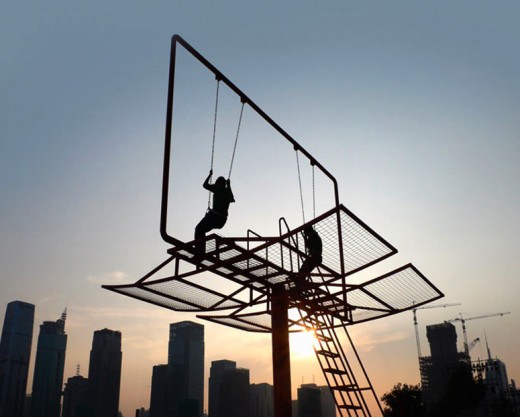
"Double Happiness responds to the society of materialism where individual desires seem to be prevailing over all."
"Double Happiness responds to the society of materialism where individual desires seem to be prevailing over all."
Wednesday, February 16, 2011
Reading #7: On Radicalism and Archigram's Amazing Technicolor Dream Crusade
I used to think that Radical architecture was kind of ridiculous, which wasn't helped by Mr. Moran's characteristically flamboyant way of lecturing about things. Some of the concepts that were the product of the Radical movement just seem downright ludicrous. The idea of blimps (named Rupert) depositing things in the middle of the night, in a city which might be composed of giant pods on legs that serve as housing, HOW ABSURD!

Well actually it's not. Even though some of their designs end up looking like sea urchins, it was a pretty good idea to think of the metropolis as an ORGANISM rather than a collection of discrete buildings bound together only by the ground plane. The drawn ideas look kind of like steampunk octopi, but the driving philosophies of the Radicals should still be considered relevant today. Designers should constantly consider the "relationship between urban space and human behavior."
What are some of the typical aspects of urban space? The positives: cultural melting pot, diversity of opportunities and experiences, socialization, public transport (if you think of that as a positive). The negatives: large income gap, high crime rates, pollution, high living expenses, and sheer population density. Lots of people favor living in the suburbs with a relatively short commute to urban centers so that they can have the best of both worlds - breathing space as well as cultural opportunity. The fact of the matter is that urbanism has an impact on the mindset of the people who live in it, and they tend to become part of this city-dwelling machine that tends to be fast-paced self-preservation from point A to point B avoiding as much traffic as possible.
Well actually it's not. Even though some of their designs end up looking like sea urchins, it was a pretty good idea to think of the metropolis as an ORGANISM rather than a collection of discrete buildings bound together only by the ground plane. The drawn ideas look kind of like steampunk octopi, but the driving philosophies of the Radicals should still be considered relevant today. Designers should constantly consider the "relationship between urban space and human behavior."
What are some of the typical aspects of urban space? The positives: cultural melting pot, diversity of opportunities and experiences, socialization, public transport (if you think of that as a positive). The negatives: large income gap, high crime rates, pollution, high living expenses, and sheer population density. Lots of people favor living in the suburbs with a relatively short commute to urban centers so that they can have the best of both worlds - breathing space as well as cultural opportunity. The fact of the matter is that urbanism has an impact on the mindset of the people who live in it, and they tend to become part of this city-dwelling machine that tends to be fast-paced self-preservation from point A to point B avoiding as much traffic as possible.
Monday, February 7, 2011
Wednesday, February 2, 2011
STARchitecture
The architect and his designs as a “spectacle” have destroyed the integrity of reality and made the world of architecture mere iconography. Star architects are less beholden to certain emotions and values of the design process; frequently their clients don’t dictate requirements for the end product so much as they think “I just want a building by Thom Mayne.”
How much team work is involved in the production of a design by a star architect? Is it really the work of only the star architect, run rampant and unchecked by any other architects or consultants of equal standing? Or is it the result of a team of minions that take care of miniscule details, the product gets stamped with approval from the head-honcho starchitect, and they become famous for what was really just a broad gesture from them?
In lesser firms composed of several architects or designers of equal skill and stature, though they may have their individual projects to work on, the design process has built-in checks and balances not only among the partners, ensuring that one partner hasn’t gone off the deep-end, but with the client as well. The client can generally afford to be picky, and if the designers aren’t producing above and beyond what the client dreams of, they’re off the project. If you manage secure Peter Eisenman as a designer, would you tell him he can’t put a giant unsealed hole in your roof if that’s what he wants?
What is the difference between “real” and “appearance?” Something that’s confused me over the last year is why people are so willing to spend money on the luxury of viewing movies in 3D or buying a 3D television when life is already in 3D? I accept that movies and television shows are artifice, and I can be engaged without being immersed in it. American society somehow believes more in the fantastical than the real. The difference is that the “real” is ultimately more fulfilling, carries more weight and integrity, than illusion. Illusion cannot be experienced beyond the visual, it cannot be questioned with the expectation of receiving answers, and it cannot be deconstructed without being destroyed.
Star architects, having achieved a level of fame or notoriety, no longer have the need to explain themselves. They are allowed to produce designs that aren’t required to hold their water (I’m looking at you, Frank Gehry). It is undeniable that the star architects have talent and vision, otherwise they couldn’t be in their current positions of prominence. But I think that in being somewhat of a celebrity and having already proved themselves (like a tenured professor), some might stop holding themselves to the standards that everyone else has to follow.
Subscribe to:
Posts (Atom)